

4. Carolina Panthers: Can the Panthers' offense return to its pre-bye success?
In the first month of the season, Bryce Young and the Panthers were humming, ranking 8th in EPA per play from weeks 1-4. Then their week 5 bye came and they haven't been nearly as effective, ranking 22nd in EPA per play since week 6.
I'm not going to pretend like I know exactly what's led to this offensive decline, but a few numbers stand out. For starters, Bryce Young has been taking sacks at a much higher rate. Carolina's sack rate has increased from 5.6% in Weeks 1–4 to 9.3% since the bye, despite its pressure rate actually decreasing from 51.7% to 42.6%.
The Panthers have also become considerably less aggressive through the air. Their average depth of target has dropped from 9.18 yards to 7.28, while their deep-pass rate has fallen from 14.3% to 9.7%. Carolina's EPA per pass has plummeted from +0.17 before the bye to -0.15 since.
I also found that the running game has actually been more efficient, with Carolina's EPA per rush improving from -0.11 to -0.01. It appears that the passing game is the primary driver of Carolina's offensive struggles.
Whatever the explanation, the Panthers have already shown they're capable of playing efficient offensive football. But if they can't figure out what's gone wrong since the bye and rediscover some of that early-season success, they risk falling behind in the NFC South race and missing out on the playoffs.
5. Minnesota Vikings: Can Kirk Cousins turn this offense around?
The Vikings are the first of three NFC North wild-card teams we will discuss. It's crazy that this division is so good there's a chance all four teams will make the playoffs, something that hasn't happened since the league expanded to three wild-card teams per conference in 2020.
Anyway, the Vikings traded for Kirk Cousins last Tuesday, reuniting him with his former head coach Kevin O'Connell and top receiver Justin Jefferson. It was an impressive return to the NFC North for Cousins, who posted a 94.4 passer rating and threw two touchdowns against the Green Bay Packers in Lambeau on Sunday. Jefferson was targeted 13 times, catching nine passes for 74 yards, showing that their connection hasn't been lost.
And this was much needed for a Vikings team that had been one of the worst offenses in football. Through the first nine weeks, Minnesota ranked 31st in EPA per play and 30th in success rate. Cousins' debut was certainly impressive, especially considering he'd only been with the team for a handful of days.
So are we good here? Can we put the offensive struggles behind us? Well, I'm not so sure.
It's not that I don't believe Cousins can still play good football. Cousins showed on Sunday that he can still run this offense, and having a receiver like Jefferson certainly makes his job easier. But he's also 38 years old, and one good performance isn't enough for me to feel confident in him leading Minnesota on a deep playoff run.
The running game doesn't make things any easier. Minnesota ranks 29th in EPA per rush, and while the running game looked better against Green Bay, it's been a problem for much of the season. But I think Cousins could help with that, too. If he can get the passing game going, it should make things easier on the ground, especially with how much O'Connell likes to use play action. The Vikings rank fifth in play-action rate this season at 31.5%, a number that jumped to 38.9% against Green Bay.
The good thing for Minnesota is that Cousins and this offense don't have to be elite. With how well the defense has played, the Vikings don't need elite quarterback play to compete with the best teams in the NFC. If Cousins can make this offense competent, that might be enough for Minnesota to make some noise in the playoffs.
Sunday was a promising start, but I'm going to need to see more before I'm convinced Minnesota's offensive problems are completely behind them.
6. Chicago Bears: Can Caleb Williams balance the spectacular with the simple?
The Bears are perfect. Nothing wrong with them whatsoever. They're a perfect collection of human beings who never warrant any criticism, especially Caleb Williams. Bear down, onto the next team.
As a Bears fan, I wish I could honestly end it there. But the offense struggled against the Tampa Bay Buccaneers at home on Sunday Night Football last week. Tampa Bay has been one of the best defenses in football this season, but it was an uncharacteristic performance for a Bears offense that had seemingly been unstoppable since Williams' return in Week 6.
From Weeks 6–9, Chicago ranked fifth in EPA per play and fourth in EPA per pass. And not only was Williams continuing to make incredible plays, but he was more consistent than ever. Entering the Tampa Bay game, Williams ranked second in the league in completion percentage at 70.9% and had thrown just one interception. His 0.6% interception rate was the fourth-lowest among qualified quarterbacks.
That's pretty remarkable for a guy whose biggest concern heading into the season was his down-to-down consistency and completion percentage.
It was a pretty good day to be a Williams hater last Sunday, as he threw four interceptions and completed just 59.5% of his passes. In fairness, two of those interceptions came on attempted throwaways, while another was the result of a deflection. It's only one game, and he'd been excellent leading up to it. But Williams needs to start recognizing when a play is over rather than trying to turn every broken play into something spectacular. His ability to make those incredible circus plays is part of what makes him special, but sometimes the best thing to do is simply to live for another down.
Chicago will need its quarterback at his best come playoff time if it wants to take the leap from being a nice story a year ago to legitimately competing for a Super Bowl in January and February.
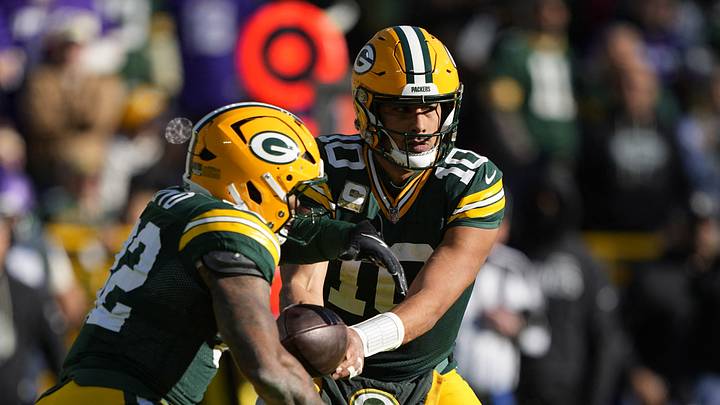
7. Green Bay Packers: Can Jordan Love carry an offense with no running game?
We talked about this last week with the Packers. Green Bay has virtually no running game. They're dead last in the NFL in EPA per rush, so there's a pretty good argument that Green Bay has the worst running game in football.
And Matt LaFleur seems to know it, too. The Packers throw the ball on 64.3% of their plays, ranking 2nd behind only the Cincinnati Bengals. The Packers have had to rely almost entirely on Jordan Love to generate offense, and until Sunday, it had been working pretty well.
In Weeks 8 and 9, Green Bay averaged +0.12 EPA per play and +0.33 EPA per pass, both top five over that stretch. The running game was still abysmal, but who cares? The offense was finding success.
That changed Sunday against Minnesota. The Vikings have one of the best defenses in football, and the Packers had absolutely no answers for it. They averaged an awful -0.32 EPA per play, struggling to get anything going through the air or on the ground. Green Bay scored just 10 points in the loss.
And it's not just that the running game isn't producing. With Green Bay struggling so much on the ground, there's even more pressure on Love to make things happen through the air. The Packers have been able to get away with that at times, but as we saw Sunday, it's a lot to ask of any quarterback, especially against the league's best defenses.
Maybe the running game improves down the stretch, but there's been little evidence to suggest a major turnaround is coming. If it doesn't, I'm not sure how far Green Bay can go in January with an offense that depends almost entirely on its quarterback.
 Add us as a preferred source on Google