

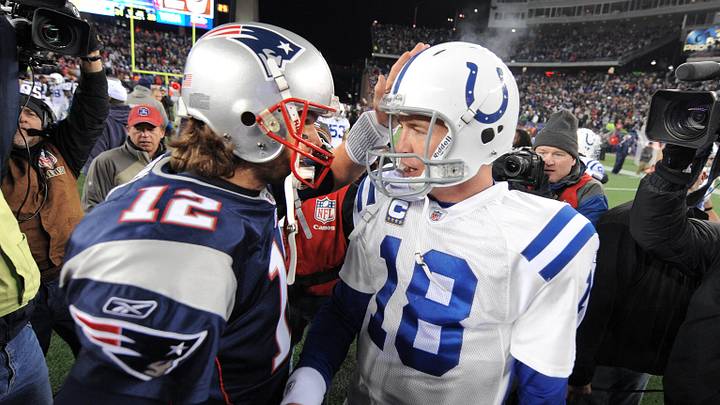
The tried-and-true notion that says the NFL will always find the most talented players no matter where they are from has certainly rung true throughout its history, as standout players have been found from all corners of the United States.
Every state has at least one player who managed to star in the NFL that they can call their own, though deciding which player is the best individual performer can make for some thought-provoking and heated debates.
These legends all stand out as the best players to ever be born in their respective states.
The best NFL players of all-time from all 50 states
Alabama: Terrell Owens
Owens may have been a lightning rod for his bombastic personality that forced a few big trades, but no one can deny his talent and consistency. Owens, who had a 900-yard receiving season at age 24 and age 37, is third all-time in touchdown catches behind only Randy Moss and Jerry Rice. Owens has five First Team All-Pros to his name.
In the early 2000s, when Owens made his All-Pro teams, he could reasonably be called the best wide receiver of that half-decade. When one disregards his quotes in the press and looks purely at what he did on the football field, Owens emerges as a singular talent who combined elite physicality on the outside with the toughness needed to play through a major injury in the Super Bowl.
Grudge-holding Hall of Fame voters may have made Owens wait for enshrinement, but he will receive no such penalty on this list.
HM: Philip Rivers, Julio Jones, Walter Jones, Bart Starr, DeMarcus Ware
Alaska: Mark Schlereth
Fans may know Schlereth as an analyst, but he was a key offensive lineman on three Super Bowl champion teams between his stints with Washington and Denver. The man they called “Stink” was one of the more underrated guards of the 1990s, making two Pro Bowls and starting 140 games.
Surgeries managed to take their toll (29, per Schlereth himself) and forced an earlier retirement than he may have wanted, but Schlereth still carved out a very respectable career blocking for names like John Elway and Terrell Davis, as well as a ‘91 Washington team regarded as one of the best ever.
Not bad for someone born and raised in the Last Frontier and a former 10th-round pick out of Idaho.
HM: Daryn Colledge, Travis Hall, Chris Kuper
Arizona: Randall McDaniel
One of the strongest players in NFL history, McDaniel has a legitimate argument to be made for the title of best offensive guard ever. The former Vikings star made 12 Pro Bowls and nine All-Pro teams (seven First Team selections) in a row, serving as a paragon of excellence and durability.
McDaniel is one of the freakiest athletes of all-time, as he has a verified 4.60 40-yard dash, 37-inch vertical leap, and 435-pound bench press to his name. Being named an All-Pro lineman at age 26 and age 34 speaks to uncommon longevity and an aura of excellence that makes McDaniel the best offensive lineman in Vikings history.
Is he a Top 10 lineman in NFL history? Considering how long his prime lasted, he certainly has an argument.
HM: Curley Culp, Cameron Jordan, Danny White, Bart Oates, Darren Woodson
Arkansas: Don Hutson
In 1942, Hutson had 74 catches, 1,211 yards, and 17 TDs. The gap between him and the second-place finisher in those categories (47 catches, 640 yards, 9 TDs) would have been good enough to finish in second place. Oh, and he played defense and had 7 INTs. Hutson recorded just under 8,000 yards and 99 touchdowns at a time when teams would go whole seasons without 10 touchdown passes.
In many ways, Hutson is the Babe Ruth of the NFL. Not only was he cartoonishly better than every other pass-catcher from this era, but he was also a trailblazer. He and quarterback Arnie Herber showed the NFL that the forward pass is not only as viable an offensive play as running the ball, but worth building an offense around.
In Hutson’s 11 years, he led the league in touchdown catches nine times and yards seven times. That, quite simply, will never happen again.
HM: Willie Roaf, Rod Smith, Cortez Kennedy, Kevin Williams, Leslie O’Neal
California: Tom Brady
California may have the greatest statewide assemblage of talent of any in the country, and they have produced the greatest player in NFL history as well. Listing off Brady’s accomplishments would take far too long, as he has put some distance between himself and everyone else who has played this game.
Even the greatest tight end and offensive tackle of all time, Tony Gonzalez and Anthony Munoz, respectively, can’t hold a candle to Brady, who set passing records that may never be broken. From humble beginnings in San Mateo to a career that put him in the upper echelon among American athletes, Brady is the truest definition of legend.
With the stats to beat out every other quarterback and the rings to match, Brady was the easiest choice on this list.
HM: Aaron Rodgers, Tony Gonzalez, Anthony Munoz, Ron Mix, Junior Seau
Colorado: Christian McCaffrey
McCaffrey’s dominant prime helped him barely beat out the longevity of Calais Campbell. A three-time First Team All-Pro, McCaffrey has an Offensive Player of the Year in his trophy case along with two top-five MVP finishes. McCaffrey has recorded three 100-catch seasons as a running back, which is completely unprecedented.
Injuries have been the only reason McCaffrey is not the No. 1 player in the state running away, as his periods of All-Pro production have been interrupted by some minor ailments. When he is on the field, McCaffrey has proven to be a uniquely talented player who set records in Carolina and nearly won a Super Bowl in San Francisco.
McCaffrey is still one of only three players who have 1,000 rushing and receiving yards in the same season.
HM: Calais Campbell, Vincent Jackson, Aaron Smith
Connecticut: Andy Robustelli
Robustelli is one of the greatest draft steals and most unlikely success stories in NFL history. Robustelli was a 19th-round pick of the Los Angeles Rams as a 25-year-old rookie from Arnold College (which does not exist anymore) who served in the Navy during World War II. He was tiny for a defensive end as well, standing just 6-0 and 230 pounds.
Robustelli would be a very good player as a Ram, but he became a legend with the New York Giants. He would finish his career with seven Pro Bowls and six First Team All-Pro selections. Robustelli has been unofficially credited with 42 sacks in 42 games between 1961 and 1963, when he was between 36 and 38 years old.
If that’s the havoc he was causing in his late 30s, that should describe what a terror he was during his prime in the 1950s.
HM: Dwight Freeney, Bill Romanowski, Eugene Robinson, Floyd Little, Ken Strong
Delaware: Brian O’Neill
A late riser from a state that isn’t historically as rich in football talent as some of its neighbors, O’Neill managed to break free from the “developmental” tag and established himself as one of the best right tackles in football. O’Neill’s best days in football are still very much in the windshield, not the rear-view mirror.
O’Neill has been a starter for the last eight seasons in Minnesota, making two Pro Bowls along the way. Far from a dominant tackle, O’Neill is still a rock-solid performer who is approaching a decade of meritorious service with Minnesota in the coming years.
In a few more years, O’Neill may have put together a fine enough career to the point where this isn’t even a debate.
HM: Luke Petitgout, Bilal Nichols, Duron Harmon
Florida: Ray Lewis
Talk about competition! Lewis had to beat out perhaps arguably the best cornerback, running back, and pass rusher of all time to emerge as the best ever from Florida. When you are perhaps the best inside linebacker who ever played the game, however, that is more than enough to put you in this exalted tier.
Lewis making 12 Pro Bowls and 10 All-Pro teams (seven First Team nods) in 17 seasons is borderline lunacy for how dominant he was during his career. Winning Defensive Player of the Year as an inside linebacker is quite a feat, but winning it twice is unheard of. Lewis’s 2,059 tackles are the most in NFL history (among qualified players), and he has 41.5 sacks and 31 interceptions along with that.
All of those gaudy accolades all came within the context of winning, as he has two Super Bowl rings to his name.
HM: Emmitt Smith, Derrick Brooks, Deion Sanders, Deacon Jones, Matthew Stafford
Georgia: Jim Brown
Fans of a certain age will say that Brown is the best player in NFL history. Based on how his prime may be the most dominant decade any player has ever had, it’s hard to argue against it. From the day he arrived in the league to the day he retired, Brown was the best player in football. Who else can say that?
Brown played nine years, and he was a First Team All-Pro in eight of them. Brown averaged over 104 rushing yards per game for his career, led the league in rushing eight times, and paced the NFL in touchdowns five times. Brown won three MVPs as a running back and finished in the top 3 in MVP voting three additional times.
Just for good measure, he led the Browns to the 1964 NFL championship. Brown retired after winning MVP at age 29, which is truly going out on top.
HM: John Hannah, Jim Parker, Kevin Mawae, Tyreek Hill, Mel Blount
Hawaii: Olin Kreutz
The Bears may not be a franchise built on individually dominant offensive players, but Kreutz is one of the few who have stood out in the last few decades. Kreutz only missed one start between 2001 and 2010, and he was one of the best centers in football when he was on the field.
Kreutz made six Pro Bowls in a row between 2001 and 2006, being named an All-Pro in 2005 and 2006. Kreutz’s great run-blocking is one of the main reasons that a limited Bears offense was productive enough to get to a Super Bowl. Kreutz is one of many solid offensive linemen to come from the Aloha State.
Both Dominic Raiola and Max Unger were solid centers, but Kreutz tops them all.
HM: Matt Blair, Dominic Raiola, DeForest Buckner, Max Unger, Marcus Mariota
Idaho: Larry Wilson
Think about how well one has to play the safety position to rank second in MVP voting. Even though Wilson’s prime was spent on some largely lousy Cardinals teams, he was consistently rated as one of the top safeties of his era, if not the best. It appears 52 interceptions in 13 years will do that.
Wilson, a member of the 1960s and 1970s All-Decade teams, is remembered fondly throughout history for being the man who helped popularize the safety blitz. A bone-jarring hitter who once picked off a pass with casts on both of his broken wrists, Wilson is one of the toughest players of all time.
Wilson also mixed in eight Pro Bowl appearances and five consecutive All-Pro nods, just to make sure he was the Gem State’s best representative.
HM: Wayne Walker, Jake Plummer, Jordan Gross
Illinois: Otto Graham
Dick Butkus is iconic and a Bears legend, but he didn’t lead his team to 10 championship games in 10 years, winning seven of them along the way. Graham is the greatest winner who has ever laced up some cleats in the NFL, as the Cleveland Browns were a preposterous 105-17-4 in games Graham started.
Graham wasn’t just a passenger handing the ball off to Marion Motley. A seven-time First Team All-Pro and three-time UPI MVP, Graham led the NFL or AAFC in passing yards five times and passing touchdowns three times. A member of the 75th and 100th Anniversary teams, Graham still owns the career record for yards per attempt.
Graham remains severely underdiscussed whenever the “best quarterbacks ever” topic is brought up.
HM: Dick Butkus, John Lynch, Steve Atwater, Shannon Sharpe, Ray Nitschke
Indiana: Rod Woodson
One recurring trend on this list is players who were equally good at the beginning and end of their careers, and Woodson fits the bill. Woodson, who picked off 71 passes in his career and ran a record 12 back for touchdowns, was a First Team All-Pro corner at age 24 and an All-Pro safety at age 37.
Woodson, who made a dizzying 11 Pro Bowls and six First Team All-Pros in his career, primarily spent with the Steelers, Ravens, and Raiders, and won Defensive Player of the Year in 1993. He was just a few votes shy of repeating in 1994, which is almost unheard of for a defensive back.
Woodson’s ball skills helped him rank third all-time in interceptions and first among players who debuted after the merger.
HM: Bob Griese, Zack Martin, Chris Doleman, Alex Karras, Bob Kuechenberg
Iowa: Kurt Warner
Warner wasn’t always the most consistent quarterback, but when he was on, there were very few in football history who could touch him. Every time Warner started a full 16 games in a season, be it with the Rams or Cardinals, his team made it to the Super Bowl, winning one as the conductor of the Greatest Show on Turf.
Warner’s first three years in St. Louis were some of the best quarterbacking in NFL history, and it helped him take home two MVP awards. Even after some bumps in the road, Warner was able to revitalize his career in Arizona and get the Cardinals within inches of a Super Bowl victory.
Considering his unlikely rise to prominence that has already been made into a movie, Warner’s story is simply iconic.
HM: Marshal Yanda, Trent Green, Jay Hilgenberg, Tristan Wirfs, Joe Burrow
Kansas: Barry Sanders
Sanders was instantly either the best or second-best running back in the NFL the moment he put on Lions blue, and he stayed at that elite level until he retired. Despite playing with bad quarterbacks and offensive lines for most of his career, Sanders was a Pro Bowl and All-Pro in each of his 10 NFL seasons (six First Team nods).
Using a slippery and elusive running style that is impossible to copy, Sanders was a one-man defensive wrecking crew. Sanders won Offensive Player of the Year twice and MVP in 1997, when he became one of just a handful of running backs to hit 2,000 yards in a season. Sanders was a few decimal points below averaging 100 yards per game over his 10-year career.
Heaven knows what Sanders would have put up if he was given Emmitt Smith’s offensive line.
HM: Will Shields, John Riggins, John Hadl, Gale Sayers, Jack Christiansen
Kentucky: Dermontti Dawson
Talk about a succession plan. Drafted to succeed Mike Webster at center, Dawson helped give the Steelers almost three consecutive decades of upper-echelon center play. Dawson has an argument to be made as the greatest center in NFL history, as he made six First Team All-Pro teams in a row during his 13-year career.
Dawson, who would go on to start 170 consecutive games for the Steelers, was the defining center of the 1990s, as his unique blend of superior movement skills and raw power for someone who wasn’t gigantic gave even the best defensive tackles trouble.
Dawson had to be quite the player to beat out Champ Bailey, and he narrowly squeaked out the win.
HM: Champ Bailey, Jim Marshall, Phil Simms, Bob Talamani, Frank Minnifield
Louisiana: Peyton Manning
Louisiana has been a hotbed for quarterback play over the years with Terry Bradshaw and all of the Manning clan, but Peyton is the best of the bunch by a country mile. The apex of Manning’s NFL career with the Colts and Broncos is as dominant and legendary a stint as any quarterback, Tom Brady included, has ever produced. Five MVPs don’t happen without all-time talent.
Manning had every passing record worth anything to his name when he retired, and it might be a very long time before anyone ever seriously makes a challenge to his five MVPs. Manning’s two championships, one each with Indianapolis and Denver, solidified his immortal status.
It might be quite a while before someone has a better passing season than Manning had in 2013.
HM: Terry Bradshaw, Marshall Faulk, Ed Reed, Aeneas Williams, Alan Faneca
Maine: John Bunting
While not on Manning’s level (if that upsets the Bunting family, I can only apologize), Bunting was a quality contributor on some very good Eagles teams. Together with Bill Bergey, Bunting formed one of the better linebacker duos of the 1970s, even if their overall record was let down by so-so offenses.
Bunting was a starter for most of his 11 seasons with the Eagles, tallying eight interceptions and 14.5 sacks in his time with Philadelphia. While he never made a Pro Bowl team, that doesn’t change how important he was to the Eagles' defense for the better part of the decade.
Even a state without a great football history like Maine can produce stars.
HM: Al Harris, Will Montgomery, Nate Davis
Maryland: NaVorro Bowman
Bowman is destined to forever end up in the “not enough people talk about what a great player he was” tier for the rest of his football life, as injuries managed to cut him down in his prime. Bowman, for a period, was the best middle linebacker in all of pro football, and there wasn’t much debate.
Bowman made three straight First Team All-Pros, tore his ACL, and then managed to come back and make All-Pro again. Bowman would be out of the league before he turned 30, but those early 2010s 49ers teams had tremendous defenses that all started with Bowman getting things organized.
Bowman’s brilliant peak wins out over the longevity of Stefon Diggs.
HM: Stefon Diggs, Cameron Wake, Julian Peterson, Chuck Foreman, Calvin Hill
Massachusetts: Nick Buoniconti
Buoniconti had two Hall of Fame careers split between two now AFC East rivals in the Patriots and Dolphins. With the then-Boston Patriots, Buoniconti was at the top of his game, picking off 24 passes in seven years and making First Team All-Pro four straight times in his iconic No. 85 jersey. When he went to Miami, he became a part of the iconic “No-Name” defense and 1972 unbeaten champions.
Buoniconti would make two All-Pro teams in Miami, even coming in second for Defensive Player of the Year in the perfect season. Buoniconti has been given every honor imaginable by both New England and Miami, and he earned a deserved spot in Canton as well.
Most 5-11 linebackers from states without a rich football developmental legacy don’t have 1/50th of the success Buoniconti accrued.
HM: Howie Long, Walt Sweeney, John Niland, Matt Hasselbeck, Tom Nalen
Michigan: Paul Krause
Krause will forever be known as the NFL’s all-time interception king, which isn’t a bad moniker as far as those things go. In an age where turnovers are getting less frequent, Krause’s 81 interceptions seem like a mark that is going to stand the test of time. Averaging five interceptions per season for 16 years is never happening again.
Krause was a Pro Bowler eight times and a First Team All-Pro three times. While Bud Grant’s Vikings defense was known for the Hall of Fame Purple People Eaters up front, Krause was what made their secondary as great as it was due to his unparalleled ball skills and ability to cover ground.
If you liked watching Ed Reed in his prime, you’d like Krause just as much, if not more.
HM: Antonio Gates, Jerome Bettis, Joe DeLammielleure, Jimmy Smith, Ed Budde
Minnesota: Larry Fitzgerald
In good times and bad, till retirement did them part, Fitzgerald stuck with Arizona and managed to pile up a statistical legacy that rivals any receiver of his heyday. No. 11 making 11 Pro Bowls in his career is quite fitting (in addition to three All-Pro selections, just to ensure his exalted status is properly honored).
Fitzgerald would finish his career with nine 1,000-yard seasons, four 100-catch seasons, and four years with 10 or more touchdowns. Playing with often well below-par quarterbacks hurt Fitzgerald a tad, but his numbers still compare favorably to just about everyone else in NFL history.
Only Jerry Rice has more receiving yards in NFL history than Fitzgerald. Every other Cardinals offensive player ever is fighting for second place.
HM: Terrell Suggs, Jim Langer, Dave Casper, Ernie Nevers, Gino Cappelletti
Mississippi: Jerry Rice
Rice may not be just the best wide receiver ever (as there is quite literally no argument to the contrary); he might be the best individual player ever. Rice was an All-Pro at age 24 and age 40 at wide receiver, which is unheard of, and his statistics dwarf even other legendary receivers when put up against one another.
13 Pro Bowls, 10 First Team All-Pro Nods, six seasons each leading the league in yards and touchdown catches, two Offensive Player of the Year awards, and somehow catching 22 touchdowns in a 12-game season give him every accolade a wide receiver could want. It might be decades before someone even sniffs Rice’s numbers.
In a state with legends like Payton and Favre, Rice being the clear runaway selection shows the class of football immortal he made himself into.
HM: Walter Payton, Brett Favre, Willie Brown, Jackie Slater, Chris Jones
Missouri: Kellen Winslow Sr.
Winslow helped redefine the tight end position, showing that tight ends can be primary parts of anyone’s passing game. Flexing out as a wide receiver, Winslow twice led the mighty Chargers’ offense in catches and was the secret ingredient that made those Dan Fouts teams click.
Winslow was without question the best tight end of the 1980s. A five-time Pro Bowler and four-time All-Pro, Winslow left some meat on the bone when he retired after his age-30 season. A few more seasons would have been enough for him to further cement his place as one of the best tight ends ever.
While Roger Wehrli is perhaps the most underrated defensive back of his era, Winslow’s impact gave him the edge here.
HM: Roger Wehrli, Justin Smith, Lionel Taylor, Russ Washington, Ezekiel Elliott
Montana: Jerry Kramer
An iconic member of Vince Lombardi’s Packers and the secret ingredient that made the Packer Sweep perhaps the most famous play in NFL history, Kramer was the best right guard of the 1960s. After being criminally overlooked for the Hall of Fame, Kramer finally took his proper place among football’s immortals.
Kramer earned five First Team All-Pro nominations and left the game as one of the greatest winners ever. In his 11 seasons with Green Bay, the Packers won five NFL championships and two Super Bowls on the strength of a running game that was made elite by Kramer’s blocking.
For the longest time, Kramer was considered the best non-Hall of Famer. The All-Decade team member was finally enshrined in 2018.
HM: Wayne Hawkins, Pat Donovan, Mike Tilleman
Nebraska: Mick Tingelhoff
Consider the fact that Tingelhoff played for 17 seasons, all of which came with the Minnesota Vikings, and he never missed a game. In those 240 consecutive starts, Tingelhoff became the best non-Fran Tarkenton offensive player on a Vikings team that was perpetually ranked as one of the best in the NFL.
Tingelhoff’s prime came between 1964 and 1969, as he was named a Pro Bowler all six years and made First Team All-Pro in all but one of those seasons. Tingelhoff’s Vikings won 10 straight division titles and won either the NFC or NFL championship four times in a five-season span.
Tingelhoff is a top-10 center ever, and he has an argument for a top-five spot.
HM: Pat Fischer, Ahman Green, Ed Husmann, Doug Betters, Randy Rasmussen
Nevada: Steven Jackson
Even on some terrible St. Louis Rams teams that had nothing going on offense except for him, Jackson was running through defenses geared almost entirely to stop him. Jackson ran for over 11,000 yards and almost 70 touchdowns in his career, which was spent almost entirely with the Rams.
Jackson, a three-time Pro Bowler, used his giant 230-pound frame to run for 1,000 yards in eight straight seasons. In 2006, Jackson led the entire NFL with over 2,300 yards from scrimmage and was fourth in Offensive Player of the Year voting.
If only Jackson was able to be on a better team with more innovative offensive coaching. Could Canton have come calling?
HM: DeMarco Murray, Ronnie Stanley, Puka Nacua, Kyle Van Noy, Max McGee
New Hampshire: Greg Landry
Landry played 11 of his 15 NFL seasons with the Lions, keeping them fighting for playoff appearances in the late 1960s and most of the 1970s. Landry finished his career with 98 touchdown passes and just over 16,000 yards, as he often jumped back and forth between starting and being a backup.
The 6-4 Landry was a bit of a pioneer, as he is one of the first and greatest dual-threat quarterbacks ever. Landry finished his career with 2,600 rushing yards and 21 rushing touchdowns, including nine during the 1972 season.
Landry had a solid coaching career as well, serving as OC for Mike Ditka’s Bears and returning to the Lions as a quarterbacks coach.
HM: Don Macek, Sherman White, Chad Eaton
New Jersey: Jim Ringo
As great as Kramer was, he may not have even been the best lineman on his own offensive line. Forrest Gregg is great, but Ringo may have a firm argument to be made as the best center ever. A star before and after Vince Lombardi arrived, Ringo made 10 Pro Bowls in his final 11 seasons.
A six-time First Team All-Pro, Ringo managed to overcome a lack of size at around 220 pounds with tremendous technique and athleticism at the center spot. Ringo is also fondly remembered by Philadelphia Eagles fans, with whom he spent the last four years of his career after a stunning trade.
Ringo was the best center of the 1950s and 1960s, and that has to count for something in these rankings.
HM: Quenton Nelson, Franco Harris, Elvin Bethea, Sam Mills, Lou Creekmur
New Mexico: Ronnie Lott
Would you dare put someone who amputated part of their finger anywhere other than No. 1 on this list? Didn’t think so. Lott was not only the best cornerback of his era for a brief period, but the former USC star then converted to safety and became perhaps the greatest player who ever laced ‘em up at that position.
One of the hardest hitters and toughest players in history, Lott was a Pro Bowler 10 times and All-Pro seven times. With 63 career interceptions, twice leading the league in that category, Lott proved to be a tremendous ballhawk, not just a hard-hitter. Those numbers came on elite 49ers teams that won four Super Bowls with No. 42 on the squad.
The two best defensive players of the 1980s are Lott and Lawrence Taylor, and one can make an argument for Lott.
HM: Tommy McDonald, Norm Evans, Tom Brookshier
New York: Rob Gronkowski
Look at Gronk’s tremendous career, which contained a peak that was as good as it gets for tight ends across NFL history. Now take another look at it, this time taking into account the fact that injuries robbed fans of perhaps an even greater peak no one else would even sniff.
Gronkowski was a first team All-Pro four times in seven years with the Patriots, and the only times he was not honored were in injury-riddled seasons. Gronkowski caught at least 10 touchdowns in five of his first six seasons, establishing him as Tom Brady’s safety blanket in many of his best seasons.
Many believe Gronkowski is the best tight end ever, and his health may be the main reason many are skeptical of his claim to this throne.
HM: Kevin Greene, Sid Luckman, Art Monk, John Mackey, Boomer Esiason
North Carolina: Bruce Matthews
Matthews has a strong case for the greatest offensive lineman ever and certainly the best interior lineman that has ever come along. Matthews has played a good chunk of games at both tackle spots in addition to his All-Pro nods at both guards spots and center. Simply put, no one is doing that again.
Matthews finished his career with 14 Pro Bowls (a record for an offensive lineman) and 10 All-Pro teams, seven of which were First Team nods. Matthews aged like a fine wine in his career, as he was an All-Pro guard in his second-to-last season at age 39.
Matthews, who played in 296 NFL games, came into the league the year Terry Bradshaw retired and played until Michael Vick was drafted. That longevity is mind-boggling.
HM: Julius Peppers, Bobby Bell, Carl Eller, Sonny Jurgensen, Chris Hanburger
North Dakota: Pete Retzlaff
Half a wide receiver and half a tight end, Retzlaff was a matchup nightmare for the Eagles of the late 1950s and early 1960s. Retzlaff led the league in 1958 and was the leading receiver on Philly’s 1960 champion. Retzlaff made five Pro Bowls and two different All-Pro teams in his career.
Retzlaff’s 1965 season, in which he tallied 1,190 yards and 10 touchdowns in a 14-game season with pre-merger passing offenses, is still one of the greatest any tight end has ever had. Style-wise, Retzlaff was a trailblazer who laid the foundation for high-end receiving tight ends like Travis Kelce today. How about that for a former 22nd-round pick?
And he was the author’s grandpa’s favorite player. That’s quite the strong endorsement.
HM: Gary Larsen, Phil Hansen, Andy Heck
Ohio: Alan Page
Page is one of only two defensive players ever to win MVP, and that gives his case for the hypothetical title of “best defensive tackle ever” some real validity. Undersized at around 245 pounds, Page was a premier pass rusher who has been unofficially credited with 148.5 sacks (eighth all-time) in his career.
Page, who recorded 8.5 sacks as a rookie in 1967 and 9.0 sacks as a grizzled veteran in 1981, has nine Pro Bowls and eight All-Pro teams (five First-Team nods), and was football’s best defensive player in the early 1970s. Page was named to the 100th Anniversary All-Time Team and the 1970s All-Decade team.
Page’s post-football career has been quite distinguished, as he served as a Minnesota Supreme Court judge for over 30 years.
HM: Charles Woodson, Travis Kelce, Jason Kelce, Ben Roethlisberger, Jack Lambert
Oklahoma: Steve Largent
When Largent retired, he held the career record for receiving yards. For a player who was cut by the Oilers and joined an expansion Seahawks team, that is quite an exceptional feat. Largent wasn’t very big or very fast, but he caught anything and everything thrown his way. That continued for 14 seasons, all with Seattle.
Excluding the strike-shortened 1982 season, Largent recorded eight straight seasons of 1,000 yards receiving. Even after so much time has past, Largent still ranks in the top 20 in receiving yards. He is one of only 12 players in NFL history who caught 100 touchdowns in their careers.
Until Jaxon Smith-Njigba gets his counting stats up, Largent has the title of greatest offensive player in Seahawks history locked up.
HM: Dan Hampton, Cornell Green, Lee Roy Selmon, Wes Welker, Mark Gastineau
Oregon: Ndamukong Suh
Suh’s reputation as a dirty player and lengthy stint bouncing around near the end of his professional career may have eroded his memory in the eyes of many younger fans, but those who saw him during his prime with the Lions will attest to the fact that he was one of the best defensive tackles in the league.
During his first seven years in the league, Suh was named a Pro Bowler five times and a First Team All-Pro three times. With 47 sacks in seven years and a reputation as one of the better run defenders in the game in the league at his back, Suh’s prime was good enough to beat out a Hall of Famer in Dave Wilcox.
A few more string Justin Herbert seasons, however, and Suh may see his spot at the top of this list snatched away.
HM: Dave Wilcox, Stan Brock, Ahmad Rashad, Jerry Smith, Justin Herbert
Pennsylvania: Aaron Donald
Stunner, right? I’ll explain. Joe Montana, Johnny Unitas, Dan Marino are three of the best players ever; all of them have a case for being in the Top 10 All-Time. However, in their primes, there was some debate over who was the best in the league. From just about the moment he entered the NFL to the moment he left, Donald was the best defensive tackle and (possibly) best defensive player.
Donald made the Pro Bowl in all 10 of his pro seasons and earned eight First Team All-Pro nods, the latter of which is tied for the most nods of any defensive player ever. Donald finished in the top-five in Defensive Player of the Year voting seven times in a row, winning it three times in a four-season span.
Donald never stopped obliterating defenses, and that’s worth him getting the top spot in a crowded field.
HM: Joe Montana, Dan Marino, Randy White, Johnny Unitas, Joe Schmidt
Rhode Island: Gerry Philbin
Philbin’s Jets teams were often heralded for their prolific Joe Namath-led offenses, but Philbin was one of the key members of an underrated defense who surrendered just seven points in their Super Bowl III victory. Philbin has been unofficially credited with 66.5 sacks during his 10-year career.
The peak of Philbin’s career in 1968 and 1969, when he was First Team All-AFL and tallied 26 quarterback takedowns. Philbin has a well-deserved reputation as one of the best pass rushers the AFL ever had, though his pass rush skills had deteriorated by the time the AFL-NFL merger came to fruition.
Even within a Jets franchise that has a surprisingly deep history of star pass rushers, Philbin’s accomplishments stand out.
HM: Steve Furness, Al Del Greco, Tom Mitchell
South Carolina: Art Shell
Shell, who missed just five games between 1970 and 1981, was a key component of some of those elite Raiders teams of the 1970s. Shell formed one of the great tackle-guard partnerships in NFL history with Gene Upshaw, though Shell’s athletic ability makes him perhaps the better pass blocker of the two.
Shell made eight Pro Bowls and is a member of the 1970s All-Decade team. Shell played a part on three different Super Bowl-winning Raiders teams, showing that he was more than capable of playing his best when the lights were brightest.
After retiring as a player, Shell would make history as the first Black head coach in modern NFL history. Shell went 56-52 and made the playoffs three times in seven seasons coaching the Raiders.
HL: Harry Carson, Richard Seymour, Donnie Shell, DeAndre Hopkins, John Abraham
South Dakota: Adam Vinatieri
Playing in the NFL for 24 seasons is quite the accomplishment, so much so that it helped Vinatieri beat out a former MVP in Norm Van Brocklin and others from the surprisingly football talent-rich Mount Rushmore state. Vinatieri owns the NFL records for most made field goals and overall points scored.
Vinatieri’s clutch kicking not only helped the Patriots seal three Super Bowls, but he played a role in getting Peyton Manning his first ring as well. How many other players can claim to have made an All-Pro team at age 42?
Even though FanSided’s Kicker Value Added shows that he may not have been the best kicker ever, he is still one of the very best to ever do it.
HM: Norm Van Brocklin, Jay Novacek, Duane Putnam, John Dutton, Ordell Braase
Tennessee: Reggie White
White played 15 seasons in the NFL, and he has at least 11 sacks in 12 of them. White made All-Pro for 13 consecutive seasons (seven times First Team), and even amassed a ridiculous 21 sacks in 12 games during a 1987 season that is as good a year as any pass rusher has ever had in NFL history.
White is just two sacks behind Bruce Smith for the all-time record, and that comes after he started his career in the USFL and sat out in 1998. White’s 1987 season won him Defensive Player of the Year with the Eagles, and he won that award again in 1998 after coming out of retirement for the Packers.
Just for good measure, he won a Super Bowl in Green Bay. Is he the greatest defensive player at any position in NFL history? Perhaps.
HM: Jason Witten, Doug Atkins, Patrick Willis, Jalen Ramsey, Gene Hickerson
Texas: Patrick Mahomes
Mahomes is an era’s defining quarterback. When so many quarterback rivalries have been divided into the “stats guy vs. winner” debate (see Manning vs. Brady), Mahomes has shut the door by being both the stat guy with multiple MVPs and the guy who won three Super Bowls and made it to five in six years.
Mahomes still has plenty of football ahead of him, but he already has a complete career. With multiple MVPs, the all-time record for yards per game, and a game-changing legacy that has forced teams to look for more mobile quarterbacks when scouting, Mahomes has become an icon.
It took Mahomes just eight years to throw for more yards than Jim Kelly and touchdowns than Terry Bradshaw.
HM: Drew Brees, LaDainian Tomlinson, Mean Joe Greene, Bob Lilly, Mike Singletary
Utah: Merlin Olsen
It was tough picking between Olsen and Steve Young, but Olsen’s accomplishments comparing favorably to many of the other best defensive tackles in the league is ultimately what led to him pulling ahead. 14 Pro Bowls in 15 years, however you shake it, is the sign of someone who was dominant for almost two decades.
A key member of the Fearsome Foursome who missed just two games in his career, Olsen piled up 91 unofficial sacks and eight All-Pro nods despite often being double and triple-teamed. Teams were more willing to let Deacon Jones go one-on-one than Olsen. Think about that.
His acting career doesn’t impact his ranking on this list, but it’s quite a nice post-football feather in his cap.
HM: Steve Young, Carnell Lake, Rulon Jones, Blaine Nye, Garrett Bolles
Vermont: Steve Wisniewski
The Green Mountain State has produced just a few dozen NFL players, but one of them proved to be a game-changing lineman for most of the 1990s. Given his career accomplishments, it’s a minor embarrassment that the Raiders legend and 1990s All-Decade Team member is not enshrined in the Hall of Fame.
In 13 seasons, Wisniewski only missed two games. With eight Pro Bowls and eight All-Pro teams (two First Team), his road-grading style was properly recognized in his prime for being nigh unbeatable. How many other offensive lineman with those accolades don’t have a gold jacket?
Wisniewski remains Vermont’s greatest contribution to the NFL by a wide margin.
HM: Bob Yates, Bob Laraba
Virginia: Lawrence Taylor
You have to be quite a great player to beat out the all-time sack leader and a quarterback who held every passing record that matters when he retired, and Taylor is that good. Taylor was not just the best defensive player of the 1980s, but he was likely the best overall player. Winning Defensive Player of the Year as a rookie (and a sophomore) should end that first debate.
The three-time DPOY won MVP in 1986, but his impact goes beyond those numbers. Taylor was so good that entire game plans were built solely around not letting him be as dominant as he was, and he still managed to amass 142 sacks in 184 games. Eight First Team All-Pro nods in 10 years is almost unheard of.
Purely on the field, Taylor was a dynamic force that even the best tackles couldn’t stop.
HM: Bruce Smith, Fran Tarkenton, Ronde Barber, Rosey Brown, Henry Jordan
Washington: John Elway
Elway didn’t have gaudy numbers for much of his career, but his Broncos teams were far from world beaters, and he managed to drag them to Super Bowls multiple times. Elway finally got his rings at the end of his career, capping off a career that helped him live up to the hype as one of the most talented quarterback prospects of all time.
Elway’s rocket arm helped him throw 300 career touchdown passes and make nine Pro Bowls in an era loaded with quarterback talent. Elway won MVP in 1987 and had three other top-five finishes, which is impressive for a guy who was throwing to Steve Watson and Ricky Nattiel for some of the biggest games of his career.
Had Elway gotten Mike Shanahan as his head coach earlier in his career, imagine the results.
HM: Brian Urlacher, Karl Mecklenburg, Budda Baker, David DeCastro, Drew Bledsoe
Washington DC: Jonathan Ogden
Why not, let’s give DC a spot. The gargantuan Ogden nearly won Offensive Rookie of the Year as an offensive lineman, which preceded an 11-season stint in which he made the Pro Bowl every single year. He was an All-Pro in all but two of those seasons, making First Team All-Pro four times.
Ogden was the Ravens’ best offensive player in an era Baltimore dominated with defense. Even as the quarterback situation remained a mess, the Ravens were always able to mash together some quality offenses together because Ogden was such a consistent presence at the left tackle spot.
Ogden is still Baltimore’s best non-Lamar Jackson offensive player ever, and the Ravens have been developed a tradition of strong linemen to honor him.
HM: Willie Wood, Len Ford, Jon Morris, Mike Curtis, Andrew Luck
West Virginia: Randy Moss
For a generation of fans, Moss was the best wide receiver they ever saw. Moss’ electric start to life in the pros with the Vikings and peak with the Patriots were strong enough to help him dominate even the best defensive backs out there. By the end of his NFL journey, Moss would rank fourth all-time in receiving yards and second in touchdowns behind Jerry Rice.
While Moss, who was named First Team All-Pro four times and led the NFL in touchdowns five times, didn’t end his career on the most dominant note, he was so good at his best that teams would try anything and everything to even limit the damage, and that was rarely successful. Turns out stopping a 6-4 receiver with NBA hops and 4.2 speed is quite hard.
Rice is better, but Moss is a firm No. 2 across NFL history. Putting him over a Top 5 pass rusher every in Gino Marchetti shows how good he was.
HM: Gino Marchetti, Chuck Howley, Sam Huff, Dennis Harrah, Rod Martin
Wisconsin: Jim Otto
There have been so many great centers out there. Based on accomplishments, Otto tops them all. The famous No. 00 made First Team All-Pro (All-AFL) 10 times in 11 seasons, which may never happen again in NFL history at the center spot. Starting 210 out of 210 games in 14 seasons is also never going to be replicated.
Otto’s numbers may have come before some of the legendary Raiders teams that Shell did battle on, but he did win an AFL championship before losing Super Bowl II. Otto is the first great Raider ever, and he helped give the notion of pro football in Oakland validity by kick-starting their exciting vertical offense.
Otto underwent 74 surgeries as a result of football, and that type of dedication warrants a spot over another great center in Mike Webster.
HM: Joe Thomas, JJ Watt, TJ Watt, Mike Webster, George Kittle
Wyoming: Boyd Dowler
Dowler has five NFL championships and two Super Bowls to his name, yet remains an eternally underrated Packer. With Lombardi’s Packers being primarily focused on running the ball and playing great defense, it is often forgotten that Dowler was the No. 1 receiver and chief downfield threat.
Even with limited opportunities, Dowler finished his career with over 7,000 yards and 40 touchdowns. A two-time Pro Bowler, Dowler would average almost 50 yards per game between 1962 and 1967. In a conservative Lombardi offense, those numbers graded on a curve are All-Pro worthy.
Dowler may not have received a ton of praise at the time, but he started on more championship teams than 99.5% of players out there.
HM: Gail Codgill, Brett Keisel, Jack Snow
 Add us as a preferred source on Google